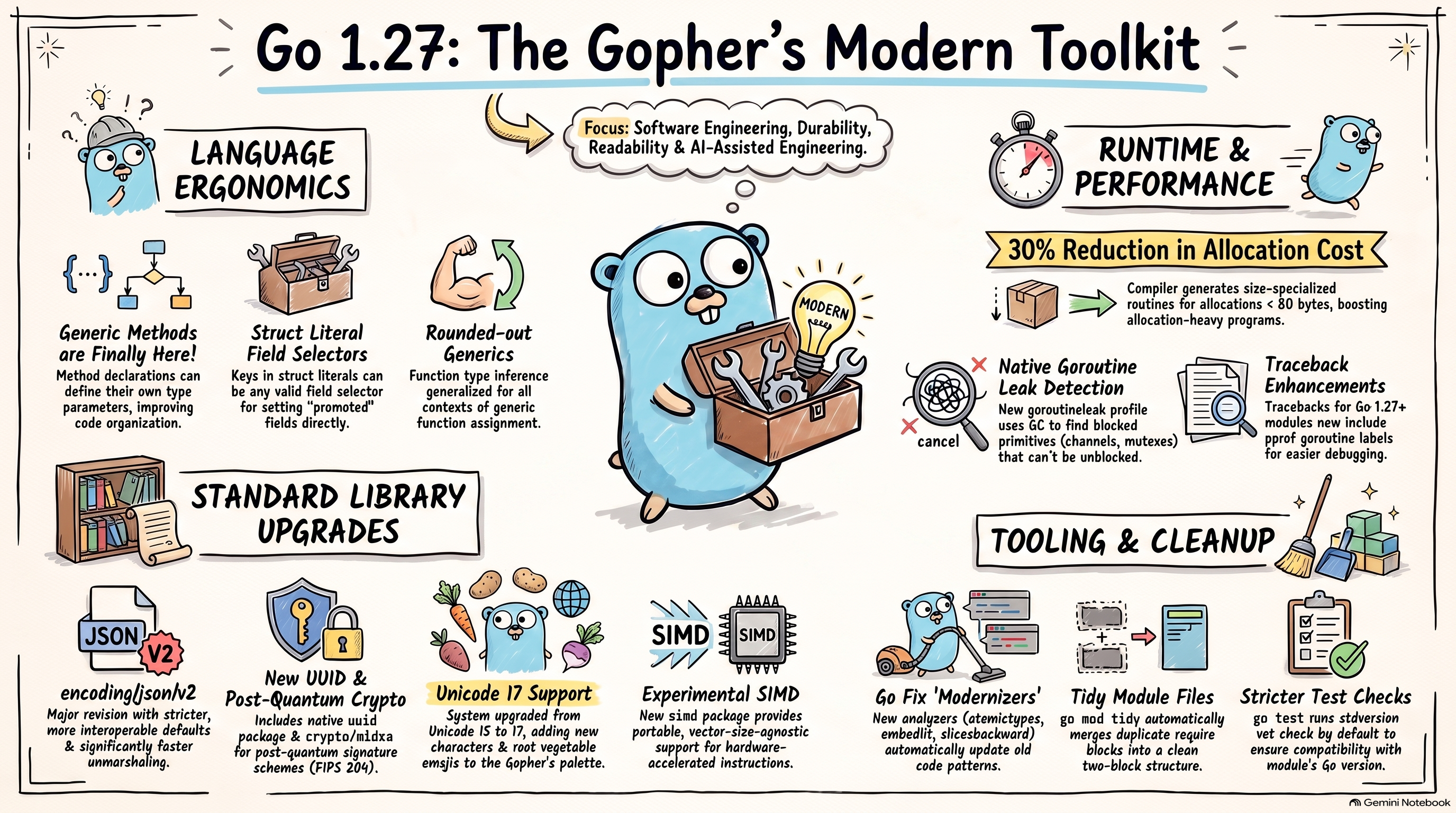
Introduction: The “Engineering Over Programming” Era Link to heading
In the Go community, we often reflect on the distinction between “programming” and “software engineering.” As Cameron Balahan, Go’s Product Lead, recently emphasized, programming is the act of writing code to solve a specific problem. Software engineering, however, is the act of building durable systems that survive over time and across teams. As Russ Cox famously put it: “Software engineering is what happens to programming when you add time and other programmers.”
Arriving in August 2026, Go 1.27 marks a significant milestone in this engineering journey. While every release brings improvements, version 1.27 focuses on “rounding out” the language. It’s an update that addresses long-standing ergonomic gaps while doubling down on the performance and security required for the next decade of systems development. For the full details, see the official release notes and the Go 1.27 Release Party hosted by JetBrains with the Go team. Here are the six features that will fundamentally change your Go workflow.
1. Generic Methods: Namespace Nirvana Link to heading
For years, the Go team and the community have debated the implementation of generic methods. In Go 1.27, the wait is over: a method declaration may now declare its own type parameters.
The Concept Previously, if you wanted to utilize generics within a type’s namespace, you were often forced to use package-level functions. Now, you can declare type parameters directly on methods. A prime example is found in math/rand/v2. Where you previously used a generic function N[Int intType](Int) Int, you can now use the method (*Rand) N[Int intType](Int) Int.
The Reflection This isn’t a radical departure; it’s a “rounding out” of the generics feature set. It keeps package namespaces cleaner and supports “fluent” programming styles by allowing generic operations to be chained directly onto types.
The Technical “Why” and Constraints Crucially, generic interface methods remain unsupported. Robert Griesemer explained that there is currently no efficient way to implement them without significant performance trade-offs. The team faced a choice between “boxing” arguments (which is slow) or “dynamic code generation” (which isn’t allowed in all execution environments). Implementing them poorly could even slow down code that doesn’t use generics at all.
“The important aspect here is that we use generic features deliberately and carefully where they’re really necessary and where they really make sense and not in other cases… Use the tool when it’s appropriate; don’t use it just because you can.” — Robert Griesemer
2. JSON v2: Stricter, Faster, and Future-Ready Link to heading
JSON handling is the heartbeat of modern web services. Go 1.27 introduces a major revision via the encoding/json/v2 and encoding/json/jsontext packages.
The Concept The new V2 API provides functions like Marshal and Unmarshal that accept variadic options for configuration. Under the hood, the original V1 API has been refactored into a thin wrapper over this new V2 implementation.
The Reflection The shift here is toward “interoperable defaults.” V2 is stricter than its predecessor to reduce “disagreements about meaning” that lead to security vulnerabilities. It rejects invalid UTF-8 in strings and duplicate names within JSON objects. While V1 was “loose” for legacy compatibility, V2 ensures that different implementations agree exactly on what the data represents.
Performance and Migration Unmarshaling performance is significantly faster in V2, while marshaling remains at parity. For those migrating from the experimental phase, take note: the unknown and format tags, as well as the DiscardUnknownMembers option, have been removed to further simplify the API.
The Tech Lead’s Escape Hatch If your team is worried about the exact text of error messages changing or encounter compatibility regressions, you can restore the original V1 implementation at build time using GOEXPERIMENT=nojsonv2.
3. Goroutine Leak Profiling: Solving the “Invisible” Problem Link to heading
A “leaked” goroutine is one blocked on a concurrency primitive (like a channel or mutex) that is no longer reachable by the garbage collector, meaning it can never be unblocked. These leaks have historically been a significant pain to debug in production.
The Reflection Go 1.27 graduates the goroutineleak profile to general availability. Accessible via runtime/pprof or the /debug/pprof/goroutineleak endpoint, this tool identifies goroutines blocked on unreachable primitives.
The “Senior Lead” Caveat While powerful, the runtime uses reachability to detect leaks. Consequently, the profiler may fail to identify leaks if the blocking primitives are still reachable through global variables or local variables of other runnable goroutines.
Monitored Primitives The runtime specifically monitors these primitives for potential leaks:
- Channels
sync.Mutexsync.Cond
4. Memory Allocation: Performance for Free Link to heading
One of the most enduring “Go mantras” is that your program should get faster simply by recompiling. Go 1.27 delivers this through the compiler’s new size-specialized allocation routines.
The Impact For small memory allocations (under 80 bytes), the compiler now generates calls to specialized routines. This results in:
- Up to a 30% reduction in allocation cost for small objects.
- An estimated 1% overall performance improvement for allocation-heavy workloads.
The Trade-off This efficiency costs a modest 60 KB increase in binary size. If you need to disable this for specific debugging or constraint reasons, you can use the build flag GOEXPERIMENT=nosizespecializedmalloc.
5. Post-Quantum Security: Future-Proofing Today Link to heading
The Go team is taking a proactive stance on “future-proofing” infrastructure against quantum computing threats that could one day break traditional encryption.
The Concept The new crypto/mldsa package implements the ML-DSA signature scheme (FIPS 204). This post-quantum cryptographic standard is designed to withstand attacks from future quantum computers.
Integration This isn’t just a side library; it’s deeply integrated into crypto/x509 and crypto/tls (specifically for TLS 1.3). By weaving these standards into the core today, the Go team ensures that the transition to post-quantum security will eventually be a simple configuration change rather than an emergency architectural rewrite.
6. Struct Literal Field Selectors: Syntactic Sweetener Link to heading
Go 1.27 introduces a small but powerful change to how we write struct literals, specifically when dealing with embedded (promoted) fields.
The Concept Struct literals can now use any valid field selector. This allows you to directly initialize promoted fields from embedded structs without explicitly constructing the inner struct.
Before vs. After
// User struct embedding Meta struct
type User struct {
    Name string `json:"name"`
    Email string `json:"email"`
    Meta
}

// Struct to be embedded by other structs
type Meta struct {
    CreatedBy string `json:"created_by"`
    UpdatedBy string `json:"updated_by"`
}

// The Old Way: Verbose and nested
u := User{
    Name: "Gopher",
    Meta: Meta{
        CreatedBy: "Admin",
    },
}

// The New Way (Go 1.27): Concise and direct
u := User{
    Name:      "Gopher",
    CreatedBy: "Admin", // Direct assignment to promoted field
}
Automated Modernizers To keep your codebase idiomatic, go fix now includes several new “Modernizers.” Specifically, the embedlit analyzer can automatically update your code to this new style. Other new modernizers include atomictypes (for atomic.Int32 etc.), slicesbackward, and unsafefuncs, ensuring your project stays current with minimal manual effort.
Conclusion: A Coherent Ecosystem Link to heading
Go 1.27 is a masterclass in balance. It provides technical depth for high-performance and high-security needs (SIMD, Post-Quantum) while simultaneously improving everyday developer ergonomics (Generic methods, Struct literals).
Crucially, this release upholds the Go 1 Promise of Compatibility. Despite major internal shifts in the JSON implementation, almost all Go programs will continue to compile and run as they did before.
The real question for developers is one of strategy: Will you adopt the “strict” interoperable defaults of JSON v2 immediately to harden your systems, or will you wait for the broader ecosystem to move first? Regardless of your choice, Go 1.27 ensures your tools are built for the long haul of software engineering.
References Link to heading
- Go 1.27 Release Notes — Official release notes covering all language changes, standard library updates, toolchain improvements, and platform-specific details.
- Go 1.27 Release Party — JetBrains-hosted livestream featuring Robert Griesemer, Alan Donovan, Joe Tsai, Marc Dougherty, and Cameron Balahan from the Go team discussing the release in depth.